Mountrail County Dog Registration Information
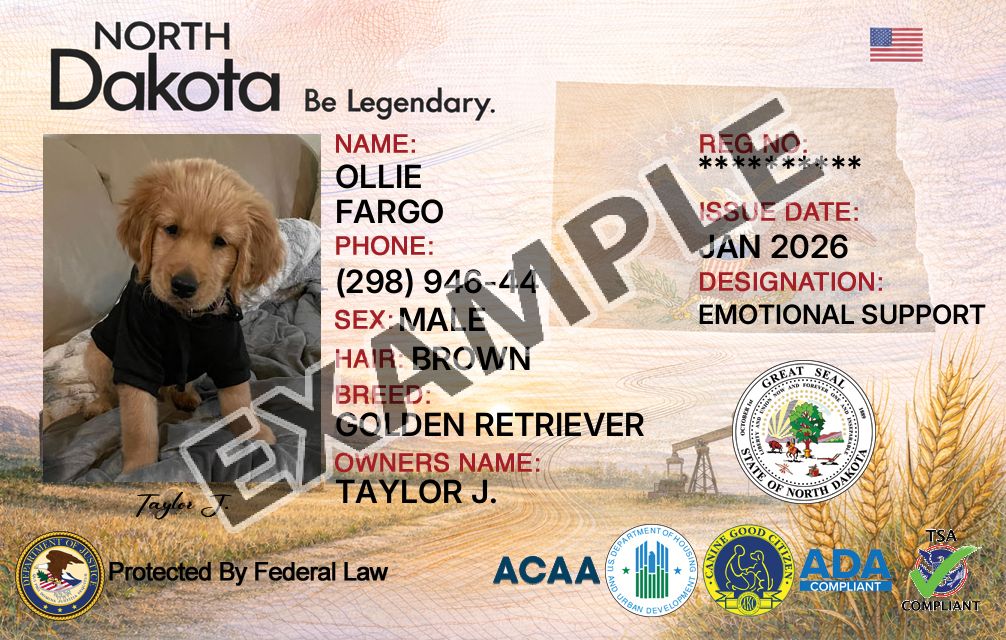
Service Dogs and Emotional Support Animals in Mountrail, North Dakota
If you’re searching where do I register my dog in Mountrail County, North Dakota for my service dog or emotional support dog, the key point is this: in North Dakota, “registration” usually means a local dog license (often issued by a city auditor/clerk) plus compliance with rabies vaccination rules and local animal ordinances. A service dog or emotional support animal (ESA) status is different from a municipal license—and you typically do not “register” a service dog or ESA with the county to make it legal.
Where to Register or License Your Dog in Mountrail County, North Dakota
Because licensing is often city-based, below are example official offices within Mountrail County, North Dakota that residents commonly contact for dog licensing, ordinance questions, stray dog pickup/impound questions, or rabies enforcement direction. If you are unsure which applies, start with your city auditor’s office (if you live in town) or the Mountrail County Sheriff’s Office (for countywide enforcement and referrals).
Mountrail County Sheriff’s Office
Address: 101 Main Street N
City/State/ZIP: Stanley, ND 58784
Phone: 701-628-2975
Office hours: Monday–Friday, 8:00 A.M. – 4:30 P.M.
Email: Not listed on the public contact block for general inquiries (see the county page for department email links).
City of Stanley — City Hall / Auditor
Address: 221 S. Main St
City/State/ZIP: Stanley, ND 58784
Phone: 701-628-2225
Email: Not displayed on the staff listing page (listed as “E-mail” link without the address shown).
City of New Town — Auditor’s Office
Temporary location: 945 Eagle Drive (North end of the mall that Subway is in)
Mailing address: P.O. Box 309
City/State/ZIP: New Town, ND 58763
Phone: 701-627-4812
Fax: 701-627-4316
Office hours: Monday–Friday, 8:00 A.M. – 4:00 P.M.
City of Parshall — City Auditor’s Office
Street address: 23 N Main St
Mailing address: P.O. Box 159
City/State/ZIP: Parshall, ND 58770
Phone: 701-862-3459
Email: cityauditor@restel.com
Office hours: Not listed on the city’s “website in development” notice.
Overview of Dog Licensing in Mountrail County, North Dakota
What “registration” usually means
When people ask where to register a dog in Mountrail County, North Dakota, they’re usually referring to a municipal dog license (sometimes called a pet license) or the local process for proving rabies vaccination and ownership. In many North Dakota communities, licensing is administered through the city auditor/clerk rather than a single countywide “animal services” department.
Why it’s handled locally
North Dakota local governments (cities) often set their own pet rules—such as how many dogs are allowed per household, whether dogs must be leashed, what counts as “at large,” and what fees apply for licensing. That’s why an animal control dog license Mountrail County, North Dakota question often resolves to: “Which city/town are you in?” If you’re in Stanley city limits, you contact Stanley’s city office. If you’re in New Town, you contact New Town’s auditor’s office, and so on.
Rabies vaccination is the most common proof requested
Even when a community’s licensing rules vary, rabies vaccination is commonly required or strongly expected for dogs. In practice, local offices may ask for a current rabies certificate (from your veterinarian) as part of licensing or when addressing animal bite or stray/impound situations.
How Dog Licensing Works Locally in Mountrail County, North Dakota
Step 1: Identify which jurisdiction you live in
The first step is to determine whether you live:
- Inside city limits (Stanley, New Town, Parshall, or another incorporated place), or
- Outside city limits (rural Mountrail County), where pet rules may be less centralized and often handled through complaint-based enforcement and rabies/animal bite procedures.
If you are inside a city, the city auditor/clerk is usually the most direct answer to where to register a dog in Mountrail County, North Dakota. If you are rural, start with the Mountrail County Sheriff’s Office for guidance on who handles animal complaints, bite reporting, and whether any township/county processes apply.
Step 2: Ask what the city requires for a license
Requirements differ by city, but commonly include:
- Rabies vaccination proof (certificate from your veterinarian)
- Owner identification
- Proof of residency (sometimes requested)
- Payment of a licensing fee (varies by city and may depend on spay/neuter status)
Step 3: Keep records current (especially rabies)
Your license/tag may be annual or tied to vaccine schedules depending on local ordinance. Keep a copy of your rabies certificate and any license paperwork in a safe place. If your dog is ever lost, picked up as a stray, or involved in a bite incident, these documents can reduce delays and clarify ownership.
What to do if you can’t find a “county dog license” form
It’s common not to find a single countywide pet licensing page in smaller or rural counties. That doesn’t mean no rules exist. It typically means the controlling rules are local (city ordinances) and enforced by city police, sheriff’s office involvement, or other local authorities. If you call your city auditor’s office and ask: “Do you issue dog licenses, and what do you require?” you’ll usually get the fastest answer.
Service Dog Laws in Mountrail County, North Dakota
A service dog is not “licensed” by the county to become a service dog
A service dog is generally defined under federal ADA guidance as a dog individually trained to do work or perform tasks for a person with a disability. That legal status does not come from buying a vest, obtaining an online certificate, or getting a special county registration.
What businesses and public offices may ask (ADA rules)
If it’s not obvious what the dog does, staff may ask only two questions:
- Is the dog a service animal required because of a disability?
- What work or task has the dog been trained to perform?
They cannot require documentation, require the dog to demonstrate the task, or ask about the nature of your disability.
Do service dogs still need a local dog license?
Often, yes. A service dog can still be subject to generally applicable local rules such as:
- Local pet licensing requirements (a dog license in Mountrail County, North Dakota through your city)
- Rabies vaccination requirements
- Leash/at-large and nuisance rules (as long as they are applied neutrally)
In other words, a service dog’s access rights are about where the dog may accompany you—not about skipping public health requirements like rabies vaccination or ignoring local control laws.
Emotional Support Animal Rules in Mountrail County, North Dakota
ESAs are not the same as service dogs for public access
An emotional support animal (ESA) may provide comfort that helps with a disability-related need, but ESAs are generally not considered service animals under the ADA for public-access purposes. That means an ESA typically does not have the same right to enter places like restaurants, grocery stores, or most public-facing businesses where pets aren’t allowed.
Where ESAs commonly apply: housing
ESAs most commonly come up in housing. Federal housing guidance uses the broader concept of assistance animals, which can include both service animals and emotional support animals in housing-related reasonable accommodation requests. Housing providers may request reliable information when the disability-related need is not obvious.
Do ESAs need a local dog license?
Yes—an ESA is still a dog (or other animal) under local animal rules. If your city requires licensing, an ESA is still expected to have the same local license and rabies vaccination documentation as other dogs. So if you’re asking where to register a dog in Mountrail County, North Dakota because it’s an ESA, the practical answer is usually the same: license through your local city office if you live within city limits.
Frequently Asked Questions
Register A Dog In Other North Dakota Counties
Select your county below to get started with your dog’s ID card. Requirements and license designs may vary by county, so choose your location to see the correct options and complete your pup’s registration.
- Adams County Dog Registration
- Barnes County Dog Registration
- Benson County Dog Registration
- Billings County Dog Registration
- Bottineau County Dog Registration
- Bowman County Dog Registration
- Burke County Dog Registration
- Burleigh County Dog Registration
- Cass County Dog Registration
- Cavalier County Dog Registration
- Dickey County Dog Registration
- Divide County Dog Registration
- Dunn County Dog Registration
- Eddy County Dog Registration
- Emmons County Dog Registration
- Foster County Dog Registration
- Golden Valley County Dog Registration
- Grand Forks County Dog Registration
- Grant County Dog Registration
- Griggs County Dog Registration
- Hettinger County Dog Registration
- Kidder County Dog Registration
- LaMoure County Dog Registration
- Logan County Dog Registration
- McHenry County Dog Registration
- McIntosh County Dog Registration
- McKenzie County Dog Registration
- McLean County Dog Registration
- Mercer County Dog Registration
- Morton County Dog Registration
- Nelson County Dog Registration
- Oliver County Dog Registration
- Pembina County Dog Registration
- Pierce County Dog Registration
- Ramsey County Dog Registration
- Ransom County Dog Registration
- Renville County Dog Registration
- Richland County Dog Registration
- Rolette County Dog Registration
- Sargent County Dog Registration
- Sheridan County Dog Registration
- Sioux County Dog Registration
- Slope County Dog Registration
- Stark County Dog Registration
- Steele County Dog Registration
- Stutsman County Dog Registration
- Towner County Dog Registration
- Traill County Dog Registration
- Walsh County Dog Registration
- Ward County Dog Registration
- Wells County Dog Registration
- Williams County Dog Registration